
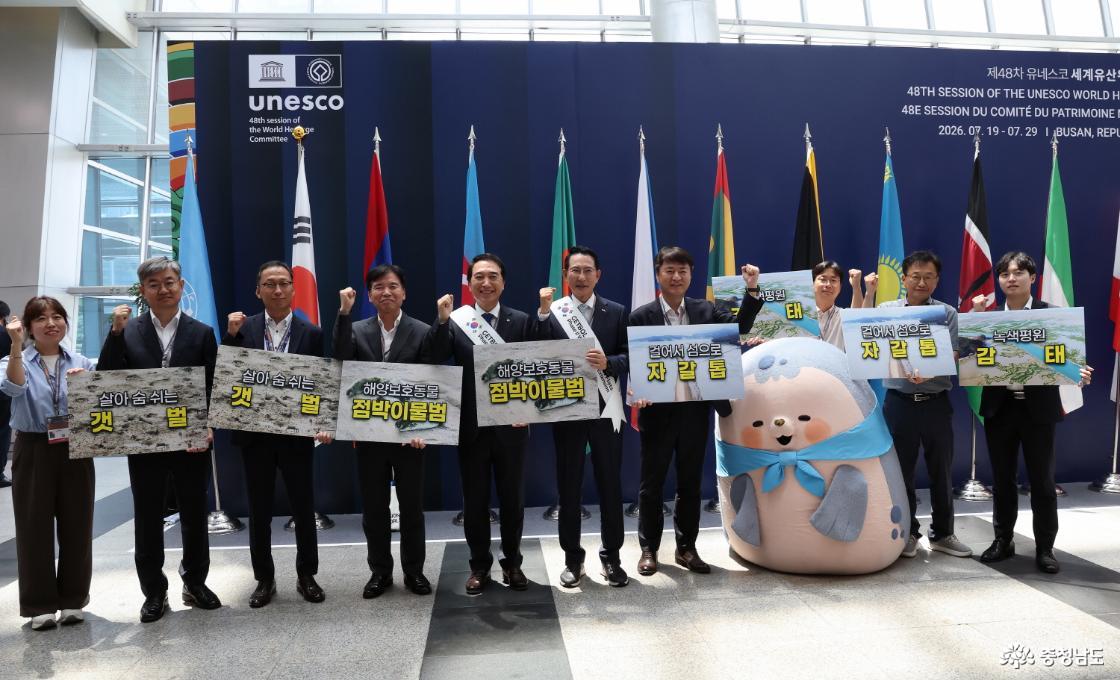
The Seosan Mudflat in Garorim Bay, Chungcheongnam-do—a natural repository of marine ecology and South Korea's first National Marine Eco-Park—has officially joined the ranks of World Heritage sites.
The provincial government announced on the 25th that the proposal to expand the World Heritage listing of 'Getbol, Korean Tidal Flats' was finally approved at the 48th session of the UNESCO World Heritage Committee held in Busan.
The Korean Tidal Flats cover an area of 1,284.11㎢ along the southwestern coast, including Seocheon, Gochang in Jeollabuk-do, and Sinan, Boseong, and Suncheon in Jeollanam-do. At the time of their initial inscription, the 44th World Heritage Committee issued a recommendation for a Phase 2 expansion and listing based on the evaluation by its advisory body, the International Union for Conservation of Nature (IUCN).
In accordance with the World Heritage Committee's recommendation, the provincial government applied last year to list the 64.67㎢ Seosan Mudflat in Garorim Bay, alongside Yeosu, Goheung, and Muan in Jeollanam-do, as Phase 2 of the Korean Tidal Flats. It has now been inscribed as a World Heritage site in recognition of its 'Outstanding Universal Value' (OUV) for its biodiversity and its role as a food source and stopover site for migratory bird species.
The IUCN evaluated that the Seosan Mudflat and others are among the world's largest and most productive mudflat ecosystems, providing crucial feeding and breeding grounds for a diverse range of migratory waterbirds at the heart of the internationally significant East Asian-Australasian Flyway (EAAF).
According to the IUCN, a significant portion of the 50 million waterbirds migrating between their breeding and wintering grounds along the EAAF rely on the coastal wetlands of the West Sea, including the Seosan Mudflat.
Among the 216 bird species inhabiting the Korean Tidal Flats, a total of 174 species reside in the Seosan Mudflat, including 32 species of shorebirds and 59 other species of waterbirds.
Among these, 14 are endangered bird species. It is also the world's largest habitat for the Chinese egret—a Class I endangered wild species and an IUCN Vulnerable (VU) species—with over 5% of the global population residing here.
Additionally, the Seosan Mudflat is home to 1% of the global populations of several bird species, including the black-faced spoonbill, Far Eastern curlew, and grey-tailed tattler.
Garorim Bay, including the Seosan Mudflat, is home to over 600 species of mudflat organisms, including legally protected species like the milky fiddler crab and Ellobium chinense. It is also famous as the nation's only inland habitat for spotted seals, which are an endangered wild species and a natural monument.
With the Seosan Mudflat's inscription as a World Heritage site, the provincial government anticipates that the biodiversity conservation and sustainable management of Garorim Bay will become easier, international interest will rise, and the Garorim Bay National Marine Eco-Park project will gain momentum.
The National Marine Eco-Park project plans to invest 150 billion won by 2032, highlighting marine resources such as spotted seals (fauna), Ecklonia cava (flora), and pebble beaches (topography) to transform Garorim Bay into a premium ecological space where nature, humanity, the ocean, and life coexist in harmony.
The province is intensively mobilizing its administrative capacity with the goal of being selected for the preliminary feasibility study this year and passing the assessment next year.
The World Heritage listing of the Seosan Mudflat is an achievement brought about through the collaborative efforts of the provincial government, Seosan City, the Korea Heritage Service, the Ministry of Oceans and Fisheries, other related agencies, and local residents.
The provincial government responded to the IUCN's on-site inspections and written inquiries by highlighting initiatives such as the enactment of the nation's first ordinance for 'Spotted Seal and Habitat Conservation' in 2021, the formation and operation of a dedicated committee, and the establishment and implementation of a habitat protection plan for the spotted seals.
Governor Park Soo-hyun, who attended the World Heritage Committee that day, welcomed the inscription, stating, "Garorim Bay has transcended being a precious natural heritage of Chungcheongnam-do and South Korea, and has now become a World Heritage site that humanity must conserve together."
Governor Park went on to emphasize, "Moving forward, the province will successfully drive the National Marine Eco-Park project, transforming Garorim Bay into a global hub for marine eco-tourism. This will breathe new life into the local economy and build a sustainable marine ecological model where conservation and utilization exist in harmony."
Garorim Bay in Seosan and Taean, which includes the Seosan Mudflat, is part of the southwestern coast tidal flats, which are among the world's top five tidal flats. It is South Korea's first and largest Marine Protected Area, covering an area of 147.05㎢ with a 162㎞ coastline and 80㎢ of mudflats. The waters feature 4 inhabited and 48 uninhabited islands.
Department in Charge Culture, Sports and Tourism Bureau, Cultural Heritage Division
Phone Number 041-635-2454